Mekong Ghost rediscovered after missing for nearly 20 years

Giant Salmon Carp (Aaptosyax grypus) rediscovered in Cambodia. Photo Courtesy of Chhut Chheana, USAID Wonders of the Mekong

Giant Salmon Carp (Aaptosyax grypus) rediscovered in Cambodia. Photo Courtesy of Chhut Chheana, USAID Wonders of the Mekong

The rediscovery of the Giant ‘Mekong Ghost’ Fish sends a message to the CBD COP16 of hope – and a reminder that freshwater ecosystems are in crisis.

While the world discusses how to save biodiversity at the CBD COP16 in Cali, Colombia, the rediscovery of the elusive Giant Salmon Carp, previously feared extinct and nicknamed the Giant Mekong Ghost Fish, was announced. The rediscovery of the large predatory fish represents an urgent call to action for all freshwater ecosystems (referred to as ‘Inland Waters’ by the Convention on Biological Diversity) and all the species, including humans, that rely on them.

A call to the COP:

Freshwater systems are the lifeblood of the planet and yet time and again they are neglected and overlooked. At this CBD COP, the voices of those concerned about freshwater continue to get louder. News of the Giant Salmon Carp’s rediscovery in the Mekong, a river vital to the everyday lives of millions of people, provides a rare opportunity to remind us all that freshwater biodiversity is at crisis point.

Delegates from around the world are currently in Cali, Colombia to set out plans for how to turn back the tide on catastrophic global biodiversity loss. The Carp’s rediscovery is a glimmer of hope that species feared extinct are still out there, surviving when the odds seem desperately stacked against them.

It is now up to policymakers to prioritise freshwaters, to ensure we do not lose this magnificent fish, and many hundreds of other freshwater wonders, forever.

Giant Salmon Carp rediscovered:

The ‘Mekong Ghost’ has been missing for nearly 20 years, and the team of scientists, led by researchers from the Inland Fisheries Research and Development Institute of the Cambodian Fisheries Administration, who rediscovered it deserve our congratulations. The Giant Salmon Carp (Aaptosyax grypus) – an ASAP species and one of SHOAL’s Priority Fishes under the 1,000 Fishes initiative – had not been documented since 2005 and was feared extinct. A few days ago, researchers published proof that the species has resurfaced in Cambodia, reigniting hope for its survival, and sparking calls for urgent conservation efforts to protect Southeast Asia’s Mekong River.

Their research, published in the journal Biological Conservation, emphasises the need for innovative conservation strategies to safeguard not only this species but the broader ecosystem of the Mekong, which has been termed a “fish superhighway” and is home to some of the largest freshwater fish on Earth.

“The rediscovery of the Giant Salmon Carp is a reason for hope, not just for this species but for the entire Mekong ecosystem,” said Bunyeth Chan, lead researcher from Svay Rieng University in Cambodia. “The Mekong ecosystem is the most productive river on Earth, producing over two million tons of fish per year.” The Mekong River holds staggering diversity, with more than 1,100 fish species alone, around 25 per cent of which are found nowhere else on Earth. The Giant Salmon Carp is one of the 90 Critically Endangered ASAP freshwater fish species and one of the five large migratory ASAP species that SHOAL and the Asian Species Action Partnership (ASAP) is working to conserve.

“The rediscovery of the Giant Salmon Carp is a reason for hope, not just for this species but for the entire Mekong ecosystem.”

Bunyeth Chan – Lead researcher, Svay Rieng University in Cambodia.

Giant Salmon Carp head Aaptosyax grypus rediscovered in Cambodia Photo Courtesy of Chhut Chheana, USAID Wonders of the Mekong
Giant Salmon Carp head. Photo Courtesy of Chhut Chheana, USAID Wonders of the Mekong

“The biodiversity of the Mekong is truly unique, and we must intensify our efforts to study and protect it,” Heng Kong, co-author of the study and director of the Inland Fisheries Research Institute in Cambodia, said. “Species like the Giant Salmon Carp are irreplaceable, and without concerted action, they could disappear forever.”

“It’s a striking fish, up to six feet long, with a hooked, s-shaped jaw and the body and bright scales of a salmon,” said Zeb Hogan, a co-author of the study and director of the Wonders of the Mekong programme at the University of Nevada, Reno. “It’s the only species in its genus of an evolutionary distinct form of large-bodied, predatory carp.

“Aaptosyax numbers are very low, and we don’t know how many populations remain, or if they are connected,” Hogan said. “The rediscovery means that with coordinated international action it may still be possible to save the species from oblivion”.

“The rediscovery provides a nice entry point to discussing some of the larger Mekong controversies and scientific knowledge gaps. It highlights the extraordinary diversity of the Mekong River, its elusive and unusual creatures, their life cycles and habitats shrouded in mystery, and species on the verge of vanishing forever. The rediscovery is a call-to-action. It’s a reason for a change in course: new science, new protections, new partnerships that can bring species – and the Mekong River – back from the brink. It’s a story with significant environmental and economic implications because the Mekong River is home to rich biodiversity and a USD 10 billion fishery”.

The research team are calling for continued community-engaged research. The USAID-funded Wonders of the Mekong programme, working in close collaboration with the Cambodian Department of Fisheries, has successfully involved local fishers in conservation efforts since the programme began in 2017. By partnering with people who live along the Mekong and its tributaries, researchers hope to continue to gather critical information on the Carp’s habitat and behaviour.

Giant Salmon Carp Aaptosyax grypus scale collection Photo Courtesy of Chhut Chheana, USAID Wonders of the Mekong
Giant Salmon Carp (Aaptosyax grypus) scale collection Photo Courtesy of Chhut Chheana, USAID Wonders of the Mekong

“Local fishers possess invaluable ecological knowledge and could be pivotal in identifying key habitats and establishing conservation zones,” said Sébastien Brosse from the Université Paul Sabatier in France, one of the study’s coauthors.

The Mekong River is a global priority for freshwater biodiversity conservation, and the Giant Salmon Carp is a powerful reminder of the rich biodiversity still present there. However, habitat degradation, overfishing and dam construction have caused widespread harm to the river and its species. Climate change poses a new and growing threat, as the region faces more prolonged drought and more severe floods. To address these issues, scientists are calling for a comprehensive, multi-faceted conservation strategy.

“Protecting its habitat would not only secure the future of this rare megafish but could also support other endangered species in the region, contributing to the overall health of the Mekong’s freshwater biodiversity,” Michael Grant, of the Center for Sustainable Tropical Fisheries and Aquaculture in Australia, said.

There is no time to waste. With the Mekong in such desperate decline, concerted and urgent impactful conservation work is needed. SHOAL currently has six projects running in the region, directly conserving at least four Critically Endangered freshwater fish species, including the Redtail Sharkminnow and the Jullien’s Golden Carp, another migratory Mekong giant.

The Wonders of the Mekong programme has done incredible work to rediscover the Giant Salmon Carp, raise urgent awareness of the plight of Mekong biodiversity, and engage local communities and international networks in vital conservation work. As a result of the rediscovery, the Cambodian Fisheries Administration has added the Giant Salmon Carp to its list of protected species. Ultimately, the survival of the species—and the Mekong’s biodiversity—depends on coordinated efforts across borders.

It is essential to the health of the planet that policymakers urgently step up and prioritise these efforts.
Michael Köck European tour update: 3

Mike with Eric Diener, curator of Zoo Hellabrunn in Munich © Michael Köck

Mike with Eric Diener, curator of Zoo Hellabrunn in Munich © Michael Köck

Michael Köck European tour update 3: Nuremberg, Germany – Stuttgart, Germany

On 11 September, I took the bus from Leipzig to Nuremberg and arrived at the zoo around noon. Director Dag Encke left an ongoing meeting to say hello and scheduled our meeting an hour later, so I had some time to visit the zoo. Nuremberg is one of only few zoos in Europe that house manatees and even dolphins. Though an hour seems a long time, I didn’t get further than seeing these animals, partly due to a heavy rain shower that rolled in.

The meeting itself was awesome! Plan G was – again – well received and several possibilities of supporting this conservation plan through the zoo were evaluated. We found a possible way to combine Goodeid conservation with the zoo’s work on Ambystoma dumerilii, the Lake Patzcuaro salamander endemic to the Pátzcuaro lake drainage.

We also discussed several support possibilities through the zoo and with organisations associated with zoos, some of which were already approached by me, others scheduled for next year.

I spent the night in Prague and visited Plzeň Zoo on 12 September, which is about one hour west of Prague. This zoo has built a house for endangered fish species, including Goodeids, so it was of course worth a visit. Curator Tomaš Peš picked me up at the train station, brought me to the zoo and showed me the exhibition. I was really impressed to see threatened fish from all continents in one room, but even more impressed that the zoo drew attention to the cooperation between hobbyists and zoos – an important relationship in conservation that I have been talking about for years.

After lunch with Tomaš, director Jiří Trávníček and his son – both of them experts in Mexican reptiles, especially rattle snakes – I presented Plan G to them and other representatives of the zoo. Already during the presentation, I was offered financial support for Plan G for this and the coming year, so Plzeň Zoo joined the Goodeid conservation alliance!

The next day I proceeded to Zoo Hellabrunn in Munich. Thanks to curator Eric Diener, who became a dear friend on this trip, I was allowed to sleep in the zoo for three nights. The wish in Munich to display Goodeids and contribute to their conservation is high, so we discussed several possible approaches, including linking Goodeid conservation with that of an Ambystoma species. A few days later I received an encouraging email from Eric, saying that Zoo Hellabrunn wants to support Plan G, initially for three years with €5,000 to €10,000 annually, focusing on a reintroduction project or a project related to reforestation.

Future Goodeid aquarium in Salzburg Zoo After enjoying a weekend off in Munich, I visited Zoo Hellbrunn. Though the name sounds very similar to Munich Zoo Hellabrunn, this zoo is located in Salzburg, the Austrian city that many people connect with Wolfgang Amadeus Mozart and Sound of Music. I met Lisa Sernow, the responsible curator and Mario Katzinger, who is responsible for everything related to South and Central America. We talked about Plan G and its dimensions, with the result that the aquarium in the so-called South America house will be changed into a Goodeid tank to create awareness and collect donation from visitors. The zoo is also willing to directly support Plan G.

Nuremberg Zoo aquarium So, six days, four zoos, one hundred per cent support – what else can be asked for! After another day in Salzburg, due to severe flooding in Austria which had caused all train and bus connections to be canceled, I finally arrived in Vienna to spend a few days with my family and take a well-deserved vacation.

Then on 22 September, I was on the bus again to meet a dear friend in Stuttgart and prepare more meetings for the Monday, starting with the Zoo in Karlsruhe that has its own conservation foundation, the “Artenschutzstiftung”. The meeting there and a few more in Switzerland and France will be part of the Travel Report number four, so stay tuned!

Nathaniel Ng: SHOAL / IUCN SSC ASAP Southeast Asia Programme Coordinator

Photo-Nat-1200×900

Nathaniel Ng: SHOAL / IUCN SSC ASAP Southeast Asia Programme Coordinator

Nathaniel Ng has joined the SHOAL team as the Southeast Asia Programme Coordinator alongside SHOAL partners IUCN SSC ASAP. He is a conservation biologist by training, with research background in population and conservation genomics and, in the years since his doctorate, has focused his efforts on the protection of life under the water’s surface, taking on aquatic-focused roles in conservation and research management in Mandai Nature, SEA Aquarium, and Mandai Wildlife Reserves, while freelancing in environmental consultation.

What’s your background?

Nathaniel: I am a conservation biologist with research specialisation in phylogenomics and population genomics and molecular ecology. I am fortunate to have enjoyed a diverse and multidisciplinary academic background, from sexual selection in insects, to Masters work in environmental science and management, on to PhD work focused on the patterns and mechanisms driving avian diversification across islands. Since completing my postgraduate degrees, I have turned my attention to freshwater fish conservation, accruing experience in conservation management and planning in the contexts of both NGOs (Mandai Nature) and zoos and aquaria (SEA Aquarium, Mandai Wildlife Group).

Where do you live?

Nathaniel: I presently live in Singapore.

What most excites you about working with SHOAL?

Nathaniel: Having worked on SHOAL/ASAP’s Strategic Framework to accelerate urgent action for Southeast Asia’s Critically Endangered freshwater fish in the past, what excites me the most is the opportunity to personally witness and help drive the protection of these oft-ignored but critical species. I am also enthusiastic about exploring the potential of roping in the expertise and interests of home hobbyists and zoos and aquaria, which could provide targeted and significant contributions to the protection of freshwater fishes.

What will your role on the team be?

Nathaniel: As the Southeast Asia Programme Coordinator, I will be managing and coordinating SHOAL’s efforts in Southeast Asia, working closely with a wide range of conservation partners (governments, scientists, communities, NGOs) with a focus on Critically Endangered species.

Gunung Halimun, Java

What do you find most interesting about freshwater species conservation?

Nathaniel: What makes freshwater species conservation challenging is also what makes it interesting: ever-growing human usage and extraction coupled with the fragility of freshwater ecosystems means that much innovation and persistence will be required to drive meaningful change. No two conservation challenges are ever going to be the same – which makes for a professional journey that is ever changing and never boring!

Do you have a favourite fish?

Nathaniel: This is too difficult of a question to answer! If I was forced to choose – maybe Parosphromenus tweediei. There’s just something about those stripes.

Nathaniel, welcome to the team!

Parosphromenus tweediei

Request for Proposals: Asia-Pacific – Fonseca Species Conservation Fund

Picture-1

Request for Proposals:

Asia-Pacific – Fonseca Species Conservation Fund

The Fonseca Species Conservation Fund is now accepting proposals for amphibians, freshwater fish, primates, small mammals, and tortoises and freshwater turtles of the Asia-Pacific region.

The second request for proposals is now live for species of the Asia-Pacific region. Submission deadline: 15 December 2024.The next requests for proposals will open 15 January 2025 for species in the Americas.

About

The Fonseca Species Conservation Fund (FSCF) was established in 2024 by the GEF and Re:wild to honour the passion of the late Gustavo Fonseca, long-standing GEF Director of Programs, for species conservation and building capacity of the next generation of conservationists.

The FSCF is a component of the Fonseca Leadership Program providing grants to field projects that promote species conservation and that are led by early career conservationists from GEF-recipient countries. The Fund permits grants of up to $25,000 for conservation efforts in GEF-recipient countries that are directed at species groups in urgent need of intervention and conservation action.

The FSCF draws on the expertise of the IUCN Species Survival Commission Specialist Group and taxon-specific conservation groups to ensure all funding goes to priority projects, mobilises the expertise of existing review boards, and is part of a wider network of support – both funding and technical – for grantees.

Get the details

Michael Köck European tour update: 2

Rostock Zoo's Aquarium

Rostock Zoo's Aquarium

Michael Köck European tour update 2: Rostock – Nuremberg, Germany

On 5 September I introduced Plan G to Rostock Zoo curator Jens Bohn and some of his colleagues. Our conservation idea was well received, the zoo wants to support Plan G and build up a Goodeid tank to promote Goodeid conservation.

In the afternoon, I had a meeting with Tim Schikora, the director of Schwerin Zoo. Although in previous correspondence with the zoo, they weren’t initially on board with participating in a freshwater fish conservation project, this changed during the meeting and the final outcome was similar to Rostock: an aquarium with Goodeids should tell the stories of threat, extinction, recovery and reintroduction, and the will to support Plan G financially was also shown. A really successful day!

I headed to Berlin on Friday 6 September. A meeting in the zoo’s aquarium was unexpectedly postponed, but this wasn’t a big problem as I planned to stay a few days in Berlin. The following day I presented Plan G to the local association of aquarists. A big success: further cooperation possibilities were discussed and Uwe Abraham, chair of the “1000-Arten-Projekt” and host of the event showed big interest in running a large Goodeid breeding facility in cooperation with the European Association of Zoos and Aquaria (EAZA), simply by increasing the capacity of aquariums of their member zoos. Future talks will happen to see how this could be achieved.

1000 Arten Projekt, Berlin

After a touristic Sunday in Berlin, I met Tobias Kohl from Stiftung Artenschutz – a foundation that supports conservation projects globally  – on Monday the 9th. I already sent an application to them weeks ago, so the visit was mostly to clarify questions about our application.

Directly after, I met Markus Klamt, curator of the Berlin Aquarium to make up for my postponed meeting from 6 September. As he spent several years in Vienna, my hometown, we had a lots to talk besides Plan G, but also our conservation project was discussed widely. I reached Leipzig later that day and slept in an apartment in the zoo.

On 10 September, I headed to the Bergzoo Halle/Saale, which is just 30 min away from Leipzig. The meeting with the director, Dennis Müller, and members of his team was great. He directly promised Plan G €5,000 annually for 2024 and for 2025, of course also in combination with an aquarium presenting Goodeids to the public.

Mike talking to Tim Schikora, director of Zoo Schwerin

In the afternoon, I met Ariel Jacken, the responsible curator of Leipzig Zoo, his curator colleague Till Rahm and members of the conservation team. Plan G was well received and I had to answer an hour of questions. After all, Leipzig has a very complex conservation strategy, which means that Plan G, which really caught their interest, needs to fit in the frame of this strategy. However, they want to support our plan, so Leipzig Zoo is eagerly looking for this possibility. Let’s cross fingers and wait for the next part of the trip, starting with Nuremberg Zoo in Germany.

Stay tuned!

Chouly Ou: SHOAL US Conservation Coordinator

Chouly-Ou-1200×900

What’s your background?

Chouly: I am an interdisciplinary conservation scientist with expertise in freshwater fish ecology, community-based conservation, and capacity development. I have worked extensively in Cambodia’s Tonle Sap Lake and the Lower Mekong River Basin, conducting research and leading conservation efforts. Throughout my career, I have held roles at the School for Field Studies-Cambodia programme, WWF-US, and BirdLife International, where I taught and researched freshwater fish ecology and conservation, managing grants, and developing local capacity.

Where do you live?

Chouly: I currently live in Virginia, United States of America, though I am originally from Cambodia.

What drew you to working with SHOAL?

Chouly: I was drawn to working with SHOAL because of its strong focus on conserving globally threatened freshwater fish species, a critical yet overlooked taxon. This role perfectly aligns with my passion and mission to make an impact on freshwater fish species and their ecosystems at the global level.

What excites you about freshwater species conservation?

Chouly: Growing up in Cambodia, where fish and freshwater ecosystems are integral to our lives and culture, I experienced firsthand the vital role of the rich diversity of fish species and their ecosystems, like the Tonle Sap Lake and Mekong River. Unfortunately, I also witnessed these fish and these systems’ increasing threats that often go unnoticed and lack the urgent attention they deserve. Seeing the incredible biodiversity and the growing threats facing them has motivated me to advocate for the conservation of freshwater species and their habitats.

What are you most looking forward to with this role?

Chouly: I am most looking forward to collaborating with communities, scientists, governments, NGOs, and private corporations to co-create long-term solutions for the recovery of the many globally threatened freshwater fish species and their ecosystems.

Do you have a favourite fish?

Chouly: It’s hard to choose, but I have a special connection to Schistura diminuta, the loach species I discovered during my Ph.D. research in Northeast Cambodia. It reminds me of how many species have yet to be discovered, yet they could become extinct before we get to know them if we do not work together to bring about conservation actions for freshwater fish species.

Chouly, a warm welcome to the team!

Chouly at work on Tonlé Sap.

Michael Köck European tour update 1: Mexico City – Rostock, Germany

Den Bla Planet Aquarium, Copenhagen, Denmark

Den Bla Planet Aquarium, Copenhagen, Denmark

Michael Köck European tour update 1: Mexico City – Rostock, Germany

Michael Köck, Chair of Plan G: the initiative to save the highly threatened Goodeinae family of Splitfins in Mexico, is currently touring zoos, public aquaria and museums across Europe with the aim of engaging stakeholders in Plan G’s conservation plan. Here, he gives his first update on the trip.
Leaving Mexico on 27 August, I arrived the following day in Copenhagen, Denmark. Next day I took a connecting flight to Sandefjord, about 20 km west of Oslo, Norway. I got picked up by a friend who brought me to his farm in Porsgrunn where I spent two days acclimatising. He is a hobby fishkeeper who has been to Mexico a few times, so we spent those days talking a lot about fish, Mexico and Plan G.

Two more friends visited us and we created some really nice ideas around Plan G. For example, one of these guys works with several friends in a company that plans ecological and sustainably functioning cities and towns, and they would be very interested to work with Teuchitlán [the town where the Golden Skiffia was successfully reintroduced] on a pro bono basis. He wants to convince his partners to support Plan G financially.

On 31 August, we all went by car to Fiskebäckskil, Sweden where I gave a talk at the 50-year anniversary of the hobbyist organisation Poecilia Scandinavia about Plan G. More than 20 people from five countries joined the meeting and the talk was well received. Directly after, Poecilia Scandinavia donated €3,000 to Plan G and another €1,500 to the Aqualab in Morelia and asked me to write an article about Plan G for one of the next issues of their magazine.

Backstage breeding tank Zoogoneticus tequila, Malmö Museum, Malmö, Sweden

I headed to Malmö on 2  September, where I had a meeting with the leader of the Aquarium of the Malmö Museum, Jesper Flygare in the morning and gave a presentation about Plan G to him and the staff. The people were impressed by our conservation work and promised to help. The museum is run by the town of Malmö and the concept doesn’t allow any straight donations, but we agreed on making an exhibition with Goodeids and a donation function for visitors, as well as promoting Plan G to the local fish club. The aquarium already keeps two species of Goodeid and even runs an ex situ conservation project for one of them, so there is already a strong connection. My presentation was followed by the head animal keeper of the Tropikariet Indoor Zoo in Helsingborg, Jonas Östander, who got invited to my presentation by the Malmö Museum team. He invited me to present Plan G to his director who is interested in supporting new conservation projects. Though my schedule was very tight, I promised to find a time slot for the next day in the late afternoon.

Presenting in front of Poecilia Scandinavia, Fiskebäckskil, Sweden

On 3 September, I paid a visit to the Den Blå Planet, Denmark’s biggest public aquarium. The head animal keeper Peter Petersen showed me around and I was impressed not only by the number of rare fish in their show tanks, but also to see huge colonies of several Goodeid species backstage. They have joined the EAZA Goodeid Ex Situ Program (EEP) and are focusing on ex situ conservation of many endangered fish species from many fish groups. I presented Plan G to Peter and he suggested he will present it to the board of directors to select Plan G to get funded by their conservation fund. Luckily, I prepared USB sticks with the Plan G logo in a little bag with Mexican sweets and a pen made of copper – a little gift from Santa Clara del Cobre near Lake Pátzcuaro for all my contacts on the tour. The USB sticks hold information about the “Guardianes del Río Teuchitlán” and SHOAL, as well as my Plan G presentation.

Starting at 14:00, I started for Helsingborg, knowing time would be tight for Tropikariet Zoo, as it closes at 17:00. Unfortunately, a taxi driver brought me to the wrong train station and I arrived 10 min too late. The zoo was informed but unfortunately no one could wait for me. I was however able to leave my little present with the USB stick, and I will for sure contact them after my return to Mexico.

On September 4 I took a ferry transfer from Trelleborg, Sweden to Rostock, Germany, where I have a visit to the local zoo scheduled for 5 September, and one to the zoo in Schwerin in the afternoon. I will let you know how these visits and the ones in Berlin thereafter went.

Stay tuned!

Interview with Michael Köck – Plan G

Michael Köck discussing goodeid conservation.

Michael Köck discussing goodeid conservation.

Interview with Michael Köck – European tour of zoos, aquaria and museums

“I thought I should introduce myself and Plan G to potential new partners in this exciting conservation plan, which has the potential to raise the bar for other projects and set new standards in freshwater conservation.”

Michael Köck

Michael and team in the field collecting goodeids in Mexico. Michael and team in the field collecting goodeids in Mexico.

Over the coming weeks Michael Köck, Chair of Plan G: the initiative to save the highly threatened Goodeinae family of Splitfins in Mexico, will travel around zoos, public aquaria and museums across Europe in a bid to engage stakeholders in an exciting and ambitious conservation plan. His travels will take him through Denmark, Sweden, Germany, the Czech Republic, Austria, Hungary, Switzerland, France and the United Kingdom and it is hoped the trip will inspire relevant organisations and generate vital funding to save these species from extinction.

We caught up with Michael to learn more.

Could you say a bit about your background – introduce yourself a little?

Michael: I am a 56-year-old Austrian biologist who worked as a curator in a public aquarium in Vienna for 18 years. Last year I gave up this well-paid job and started working in freshwater fish conservation in Mexico, as the Chair of a 10-year conservation plan for an endemic Mexican fish group called Splitfins (subfamily Goodeinae, family Goodeidae). If you ask me why I gave up my job to work in Mexico, I will answer because I have seen what the people in this country are capable of achieving. I was impressed by the success they were able to reach with limited resources and I wanted to be part of this movement. I have faith in this community: Mexicans are incredible when they want to arrive at something and the people I work with are passionate about succeeding in conservation. I’m here to help them where I can and to learn from them whenever I can.

What is the purpose of this European tour?

Michael: The overall aim of this European zoo tour is to encourage zoos and public aquaria to become more involved in the conservation of Mexican Goodeid fish and to create something like a Goodeid Conservation Alliance. This unique group of fish is one of the most endangered in the world: 90% of the described species are threatened with extinction according to the IUCN and are therefore already in the focus of conservation efforts by many zoos and organisations. However, we want to unite all these efforts under one umbrella, and as the projects in our Plan G portfolio follow the one plan approach, meaning they include both ex situ and in situ work and involve local communities, they are certainly of interest to many zoos and public aquaria.

What are some of the key places you’ll visit?

Michael:Certainly the big zoos in Berlin, Leipzig, Nuremberg and Munich are important places, as well as Basel and Zurich, but there are others I’m looking forward to, such as Budapest and the museum in Malmö, which already play an important role in the conservation of Goodeids, or the zoo in Pilsen with a house for endangered fish. Honestly, every place I visit will be a highlight on my tour and I’m looking forward to each and every one of them.

Michael and colleagues

Why did you choose these places in particular?

Michael:I have selected zoos and public aquaria that are already contributing to the conservation of the Goodeids or Mexican freshwater fish and that I will be able to reach on my tour. There are public institutions that I have known for many years and where people I call friends work, and there are others where I only know the key people virtually, and finally there are zoos that claim to be strongly committed to conservation but have not worked with fish before. These are the most exciting ones as you never know if they are also interested in freshwater fish, but as freshwater habitats are the most threatened in the world, some zoos have broadened their focus and are open to dialogue. All in all, a mixture of good old friends and hopefully new contacts.

It’s a lot of travelling! And a lot of visiting zoos, aquaria and museums. Have you done anything like this before?

Michael: No, this is something I’ve never done before. That’s what came to mind when we launched Plan G, and with it my role of chair and ambassador. So I thought I should introduce myself and Plan G to potential new partners in this exciting conservation plan, which has the potential to raise the bar for other projects and set new standards in freshwater conservation. Every penny and cent counts for these fish, and every metre on this journey is worth it. In the end, I should have visited more than 30 zoos and public aquaria in 48 days and hopefully gained more members for the Goodeid Conservation Alliance.

What can zoos, aquaria and museums offer as key allies in conservation?

Michael:Zoos, aquaria and museums reach a large group of people. Zoo visitors, who don’t really think of fish when they think of endangered animals, are awakened and interested, and lectures in museums could reach a whole new audience. By working together with them, the circle of people we can reach with our conservation efforts expands enormously. Temporary actions in zoos to create support or raise money, or the conservation euro collected by several German zoos, contribute directly to conservation and the network between zoos strengthens such an alliance and makes it very stable. As it stands, however, it is easier to approach zoos and public aquaria than museums, although the latter probably need a slightly different approach.

Michael and colleague in in the field.

Finally, what are your hopes and expectations with this tour?

Michael:It would be presumptuous to have any expectations for this tour. The budget for this year has already been spent or committed, so I’m not thinking about immediate support. In the long term, I hope that I can convince many of the places I visit how important their contribution is. Protecting freshwater fish is not just about reintroducing a species, but also about listening to the local people, trying to understand their problems, aspirations and hopes, and it involves trying to get them on board and working with them to solve their problems.

This also includes environmental education and social work. A healthy, clean lake is something that everyone wants, but that the people who live on it and from it often cannot afford. But with smart and clever ideas and the will of multiple stakeholders, we could build something like a constructed wetland that helps clean the lake’s wastewater, and if you plant it with flowers that a women’s startup can sell at markets, you are not only cleaning a lake, but you are also helping to increase the community’s wealth and promote gender equality. Conservation work starts with the people and ends with them. I hope that many of the places I visit in Europe recognise this and help us find a balance between freshwater habitat conservation and people’s needs that can serve as a model for the rest of the world.

The zoos, aquaria and museums Michael will be visiting:

Monday 02 September: Malmö Museum.

Tuesday 03 September: Den Blå Planet Aquarium.

Wednesday 04 September:  Rostock Zoo.

Thursday 05 September: Schwerin Zoo.

Friday 06 September: Aquarium Berlin (morning), Tierpark Berlin (afternoon).

Saturday 07 September: 1000 Arten-Projekt and Berlin Group of Livebearer breeders.

Monday 09 September: Stiftung Artenschutz.

Tuesday 10 September: Bergzoo Halle (morning), Zoo Leipzig (afternoon).

Wednesday 11 September: Zoo Nuremberg.

Thursday 12 September: Zoo Pilsen (morning) , then Prague (afternoon, pending).

Friday 13 September: Zoo Hellabrunn, Munich.

Saturday 14 September: Museum Mensch & Natur.

Monday 16 September: Zoo Salzburg Hellbrunn (morning), Haus der Natur (afternoon, pending).

Tuesday 17 September: Zoo and Aquazoo Schmiding (pending).

Monday 23 September: Zoo Karlsruhe (morning, pending), Keplergymnasium Pforzheim (afternoon).

Tuesday 24 September: Zoo Zürich (morning), Zoo Basel (afternoon).

Wednesday 25 September:Wilhelma, Stuttgart (morning), Zoo Mulhouse (afternoon, pending).

Thursday 26 September: Zoo Nancy (pending)

Friday 27 September: Aquarium Tropical and Parc Zoologique Paris.

Monday 30 September: Bristol Zoo Gardens (morning), and Tropiquaria Zoo (afternoon).

Tuesday 01 October: Whipsnade Zoo (morning), Hertfordshire Zoo (afternoon).

Wednesday 02 October: Chester Zoo (morning), Blue Planet Aquarium (afternoon).

Thursday 03 October: Bolton Museum Aquarium and Ornamental Aquatic Wholesale.

Friday 04 October: Budapest Zoo (morning) and Tropicarium Budapest (afternoon).

Monday 07 October: Sosto Zoo (afternoon).

Let’s talk about the rock threadtail

A photograph of a rock threadtail, a long black insect with very delicate wings.

For Insect Week we’re shining the spotlight on one of our finest Fantastic Freshwater insects.

Meet the rock threadtail

Perched on stones set in the rocky streams of eastern Zimbabwe is one of our most delicate fantastic freshwater species. First discovered in 2013 in Chimanimani National Park, the rock threadtail (Elattoneura lapidaria) was described in 2015, then listed as critically endangered in 2017.

This damselfly is found at whopping elevations, as high as 1500-1600m above sea level in the Chimanimani Mountains. Endemic to Eastern Zimbabwe, the species is only found in the Bundi Plain and Bundi Valley.

Damsel(fly) in distress

The rock threadtail is one of the 50 landmark species at high risk of extinction identified in SHOAL’s Fantastic Freshwater* report. Published on 19th May 2022 (International Day for Biodiversity), Fantastic Freshwater highlights the diversity and beauty of freshwater species and the immense threats they face to their survival.

Like many of our Fantastic Freshwater species, threats to the rock threadtail are largely a result of degradation of their habitat – in this instance as a result of particularly prolific illegal gold mining activity.

Despite Chimanimani National Park being a protected area, more and more people are travelling to eastern Zimbabwe hoping to find gold, including the park rangers. The activity has caused great harm to the natural water sources and biodiversity of the region and poses a major threat to the future of the rock threadtail.

A photograph of the rock threadtail’s habitat, grassy mountains surrounding a stream.

Panning for solutions

At this stage further research of the habitat in Chimanimani National Park is needed, in order to address activities that are threatening the rock threadtail and develop a plan for meaningful conservation action.

If you want to support the work SHOAL are doing to conserve freshwater species through action-driven conservationdonate here and don’t forget to subscribe to our newsletter The Stream to get all the latest freshwater news straight to your inbox

*TheFantastic Freshwater: 50 landmark species for conservation report is led by SHOAL, the IUCN Species Survival Commission (SSC), the IUCN SSC Freshwater Conservation Committee, and the Global Center for Species Survival at the Indianapolis Zoo.

1000 Fishes Blueprint webinars

1000 Fishes Blueprint

1000 Fishes Blueprint

1,000 Fishes Blueprint webinars

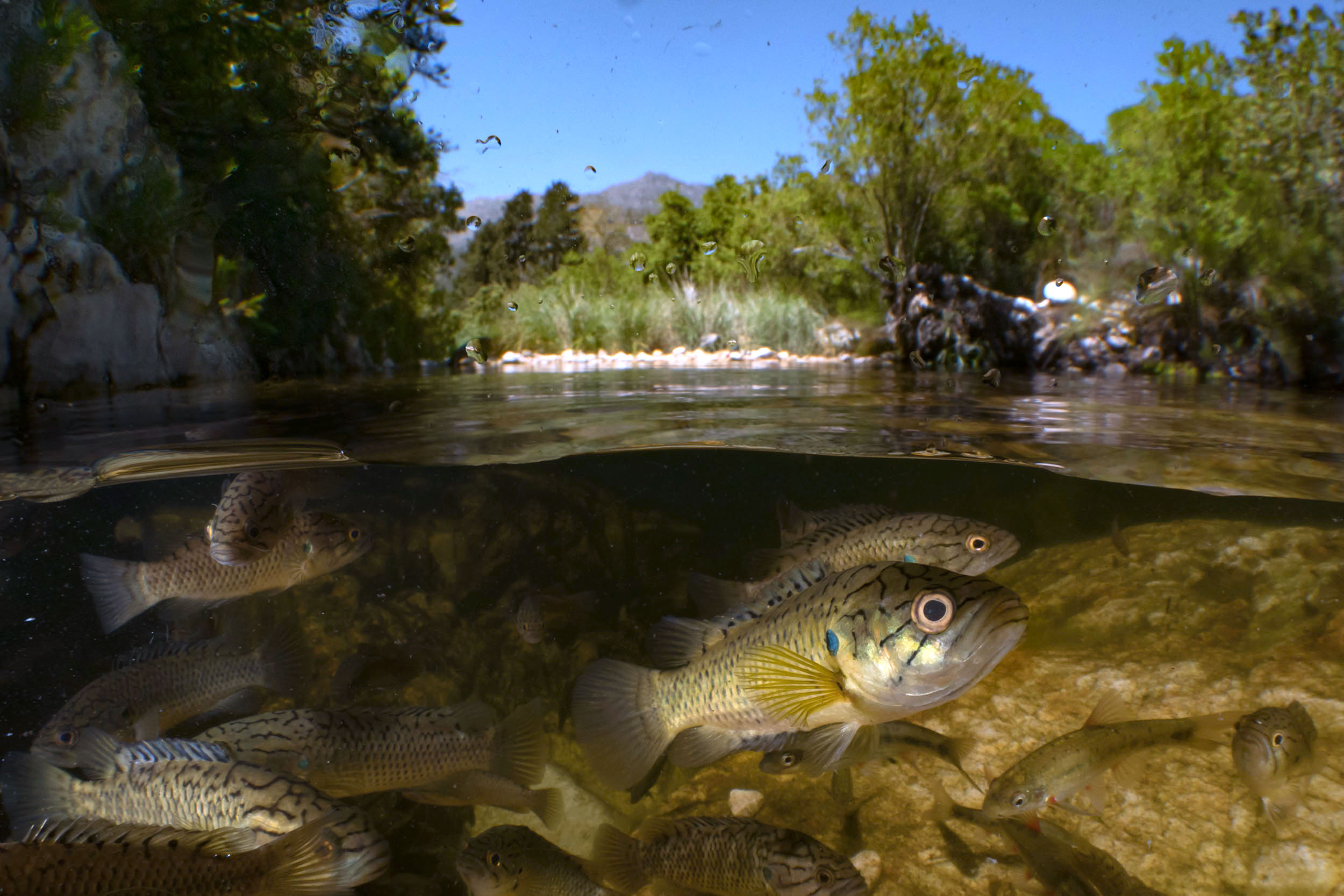
Catch up on SHOAL’s webinars to discuss April’s release of the 1,000 Fishes Blueprint.

Hear from Brian Zimmerman, Co-Chair of the IUCN SSC Freshwater Fish Specialist Group, Topiltzin Contreras-Macbeath, Co-Chair of the IUCN SSC Freshwater Conservation Committee, Rajeev Raghavan, Assistant Professor at the Kerala University of Fisheries and Ocean Studies, and Mike Baltzer, SHOAL’s Executive Director as they discuss the Blueprint and some of the outstanding work already being done to mobilise conservation action for some of the Priority Fishes highlighted.

WEST

EAST