The SHOAL is the global ecosystem of partners and collaborators who work together to safeguard the health of Earth's freshwater habitats and conserve the most threatened freshwater species. As with a shoal of fish, the strength of the SHOAL lies with the number of partners all working together.
Blueprint for Conservation Action for 1,000 Freshwater Fishes
SHOAL's flagship initiative sets out a plan for how significant collaborative conservation effort can lift freshwater fishes and potentially thousands of other neglected freshwater species to a new elevated platform of conservation attention and greatly enhance freshwater conservation efforts globally.
How an innovative, open-access platform is helping transform freshwater biodiversity information into better conservation decisions.
CELEBRATING THE ORGANISATIONS DOING WONDERFUL WORK IN THE WORLD OF FRESHWATER SPECIES CONSERVATION
GUEST POST: JEREMY SHELTON, FRESHWATER CONSERVATION BIOLOGIST, FBIS AFRICA
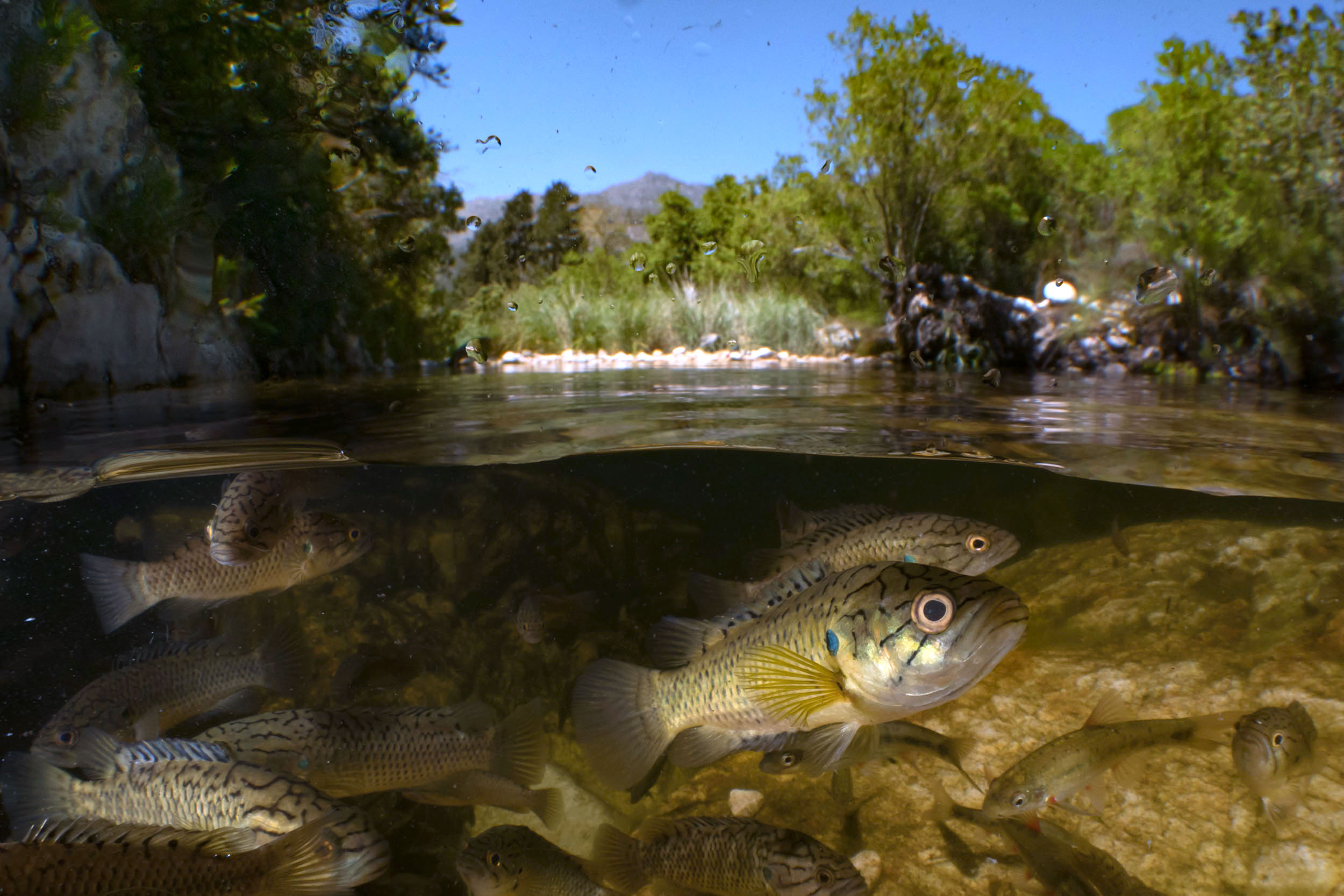
Africa is home to an extraordinary diversity of freshwater life.More than 3,200 freshwater fish species have been recorded across the continent — over a quarter of the world’s freshwater fish diversity— with many more awaiting discovery. From the Congo Basin to South Africa’s mountain streams, these fishes sustain ecosystems, food security, livelihoods and recreational fisheries, supporting millions of people.
Yet freshwater ecosystems are among the most threatened on Earth. Since 1970, two-thirds of the world’s wetlands have been degraded or destroyed, while monitored freshwater wildlife populations have declined by an average of 85%. Across Africa, habitat degradation, dams, overabstraction, pollution, overfishing, invasive species and climate change are pushing freshwater fishes towards extinction.
Protecting this remarkable biodiversity requires urgent conservation action. But there is a fundamental challenge:we often lack access to the information needed to make informed conservation decisions.
Africa’s freshwater biodiversity data challenge
Across the continent, decades of valuable biodiversity data remain scattered across scientific publications, museum collections, institutional databases and researchers’ computers. Much of this information is difficult to access or use, leaving conservation practitioners and decision-makers without the evidence they need.
Without reliable information about where species occur, how their distributions are changing and which populations are most threatened, it becomes difficult to identify priority areas for conservation, assess development impacts or plan effective restoration interventions.
The problem is not always a lack of data, but a lack of access to data that already exist.
To address this challenge, the Freshwater Research Centre (FRC), together with partners Kartoza (technical partner), The Nature Conservancy, The Wilderness Project, African Parks, WWF, Re:wild, Conservation International, SHOAL and a growing network of African collaborators, is developing theFreshwater Biodiversity Information System for Africa (FBIS-Africa).
This free, open-access platform aims to transform how freshwater biodiversity information is mobilised, shared and used across the continent.
By bringing together species occurrence records from multiple sources, FBIS-Africa enables researchers, conservation practitioners and policymakers to explore species distributions, identify biodiversity hotspots and prioritise conservation action.
The platform provides interactive maps, biodiversity dashboards, spatial analysis tools and downloadable datasets. It also links species information to IUCN conservation assessments and exchanges occurrence records with the Global Biodiversity Information Facility (GBIF), making African freshwater biodiversity information more accessible locally and globally.
Crucially, these tools support the development of practical conservation products, includingspecies Red List assessments, protected area expansion plans and spatial biodiversity assessments.
But the real value of FBIS-Africa lies not simply in the amount of data it holds, but inhow those data can drive conservation action.
From data to impact: Protecting South Africa’s threatened freshwater fishes
The potential of this approach has already been demonstrated in South Africa, where the original Freshwater Biodiversity Information System (FBIS) has supported conservation planning at a national scale.
In a landmark study published in 2023, researchers used FBIS to compile and verify6,660 occurrence records representing 34 threatened freshwater fish taxa. These records were used to develop maps showing where threatened fishes occur and where suitable habitats are likely to exist.
These maps were incorporated into South Africa’s National Environmental Screening Tool, used to assess the potential environmental impacts of proposed developments. For the first time, threatened freshwater fishes were explicitly represented in this national decision-support tool, helping ensure their habitats are considered in development planning.
FBIS Africa map interface
One species included was theClanwilliam Sandfish (Labeo seeberi), a large, migratory freshwater fish endemic to South Africa’s Olifants-Doring River System. Once abundant throughout the catchment, this remarkable fish has disappeared from much of its former range, largely due to predation by invasive alien fishes.
By combining historical and recent Sandfish records, researchers modelled its distribution and identified environmentally sensitive river habitats. These maps now contribute to national environmental screening, helping flag areas where developments could threaten the species.
The Sandfish is also the focus of FRC’sSaving Sandfishproject, combining scientific monitoring, community involvement, protection of vulnerable juvenile fish and reintroductions to rebuild depleted populations. Together, these initiatives demonstrate how accessible biodiversity information and hands-on restoration can complement one another.
What has been achieved in South Africa offers a glimpse of what could be possible across the continent.
Africa has already committed to ambitious freshwater conservation targets.Twenty African countries have joined the global Freshwater Challenge, while SHOAL’s 1,000 Fishes Blueprintidentifies approximately 200 threatened African freshwater fishes requiring urgent conservation action.
Achieving these ambitions requires reliable biodiversity information to identify priorities, direct investment and measure progress.
FBIS-Africa aims to support this process by working with African researchers, institutions and conservation organisations to mobilise existing datasets and strengthen data management capacity. Through partnerships, training workshops and a dedicated small grants programme, the initiative is building a network of African data contributors and users.
The ambition is not simply to build a bigger database, but totransform biodiversity data into better conservation decisions— helping countries identify priority rivers, protect critical habitats, guide restoration and prevent species extinctions.
Turning knowledge into conservation action
Saving Africa’s freshwater fishes will require sustained investment, collaboration and bold conservation action. But effective conservation starts with good information.
The South African experience demonstrates how making biodiversity data accessible can translate scientific knowledge into practical conservation planning. FBIS-Africa aims to replicate and expand this impact across the continent, connecting people, information and conservation action.
Because every biodiversity record is a piece of the conservation puzzle — and together, they can help turn the tide on freshwater fish extinctions.
Reference: Kajee et al. (2023). How the Freshwater Biodiversity Information System (FBIS) is supporting national freshwater fish conservation decisions in South Africa. Frontiers in Environmental Science.https://doi.org/10.3389/fenvs.2023.1122223


)
)
)




)